Much Ado About Nothing
Source
Keynote address to the Jewellers Metal and Goldsmiths Association Conference ‘Peripheral Visions´, held in Hobart 10-11th January (1998)
What's precious in an information age?
 The
omega watch
The
omega watch
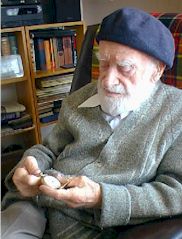
A snowy white beard tops a knitted grey woollen cardigan. ‘I’m hanging on’, he says, folding his body of ninety-five years into an armchair. There’s a hint of bemused resignation in his voice—grateful for the extra time he’s been allotted, but aware that parts of his anatomy have outlived it. He has a softness now, as though his body has returned to the downy warmth of infancy.
He hasn’t always been so soft. After migrating from Poland with his family when he was three years old, he was been forced to adapt to the rigours of life in the bush. As a young father, this man maintained a country practice, performing up to 300 operations a year in his rudimentary surgery. He was a champion pistol shooter and excellent amateur photographer—by all accounts, he was once a very hard man.
They are like too different men—the hard and the soft ones. Their common residence in the same life is one of the mysteries that lends a human biography the kind of depth many treasure. It invites the question: what element links these two opposites into the same life?
The question of biographical continuity is in many ways a symbolic issue—it’s more a matter of accoutrements of identity such as proper name than the deeper layers of self. When we ask this man to tell us about the time, he reaches into his trouser pocket and retrieves an old fob watch. When we ask him to tell us about the source of this time, he explains carefully about the technical advantages of an Omega watch. His own watch testifies to the company’s workmanship. He purchased it in his second year of Medicine at the University of Melbourne. That was in 1922, the year when James Joyce’s book Ulysses was published, when there was a craze for Omega watches. His cost 10 pounds, or in contemporary ‘real terms’ around $2000 Australian.
Seventy-five years later and it doesn’t miss a beat. While its durability has much to do with the engineering at Omega, it also owes greatly to its keeper. Roughly 27,375 times he gently wound the watch. Perhaps 100,000 times he would open it, each time taking special care to hold its top steady so that it didn’t spring open. This one minor movement applied consistently over the decades has guaranteed its longevity.
This moral tale partakes of a time-honoured partnership between humans and their things. The sentimentality of this story is tempered a little by the nature of the object. After all, the watch is merely a cog in a much larger network that couples a human body with the great machinery of the industrial world. I don’t think we can consider the story of the Omega man without some regard for the subsequent decline in the value of things. Think of how time is told now. Most of us inherited a timekeeping that had migrated from the pocket to the wrist, but since then time has been liberated from its confinement and may be found throughout the material world. There are time read-outs on the variety of LCD screens that feature in gadgets, such as VCRs, desktop computers and car dashboards. I challenge you to think of new nooks that have been recently colonised by time.
 Paper
Paper
The liberation of time is one of a chorus of stories belonging to what we call the ‘digital revolution’. The great catchcry of this revolution is ‘information wants to be free’. One of the most vocal champions of this phrase is John Perry Barlow, once member of the Grateful Dead. For him, the necessary freedom of information follows from the positive relationship between value and distribution. In his simple logic: ‘If I sell you my horse, I can’t ride him after that. If I sell you what I know, we both know it….’ We’ll return to Barlow later.
Revolutions have their dark side—the scandals of abuse that prompt moral outrage, such as the Bastille in 18th century France or the shoe collections of Imelda Marcos. In the shadow of the digital revolution lies the devastation of our natural resources. Think of the forests that have been destroyed to support the print industry. The MIT Media Lab can be viewed as the central committee of the digital revolution. Its head, Nicholas Negroponte, describes the culture of print as ‘squirting ink onto dead trees’.
 The
print phase of the information revolution has brought reams of paper to
our front door everyday: newspapers, letters, catalogues, advertising,
bills and magazines. Before the digital networks are ‘rolled out’,
this flow accelerates—note how much thicker envelopes containing
bills are now with banks and utilities including glossy brochures advertising
new deals. We all await the day when the digital revolution will sweep
away all this waste and replace it with a freely flowing stream of information.
The
print phase of the information revolution has brought reams of paper to
our front door everyday: newspapers, letters, catalogues, advertising,
bills and magazines. Before the digital networks are ‘rolled out’,
this flow accelerates—note how much thicker envelopes containing
bills are now with banks and utilities including glossy brochures advertising
new deals. We all await the day when the digital revolution will sweep
away all this waste and replace it with a freely flowing stream of information.
 The
Future of the Object
The
Future of the Object
When this day comes, the most likely place for the Omega watch is no longer a trouser pocket but a museum cabinet. And what will take its place as an object to be treasured and proudly displayed by residents of nursing homes midway through the next century?
Gallery Ra
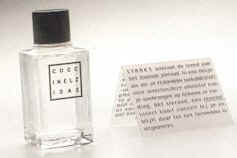
Many of you will be familiar with the array of possibilities gathered together for the Gallery Ra Award, which featured last year at the Craft Victoria gallery. One distinct trend was towards a less material kind of jewellery. A particularly clever example of this was Dinie Besems’ Coccinelzidae. The jewellery is not the jar but the liquid it contains: a pheromone that when worn attracts a colourful insect for the duration of the scent. It becomes a standard exercise from students of jewellery to formulate ornamentation that are purely conceptual, such as phrases of language.
Devices
While one path for jewellery leads into the ethereal realms of conceptualism, another follows closely the progress of the digital revolution. For this new soft world to function, it will need devices to channel this stream of information. As the clunky screen is superseded by a general environmental ‘smartness’, thanks to miniaturisation, designers will be looking to subtler means for us to assist information in its circulation. For some reason, the Dutch seem as much concerned with this practical future of jewellery, as well as its conceptual possibilities.
The Phillips company has a web site ‘Vision of the Future’ that displays prototypes of high-tech personal devices for adorning the body. Among their smart devices is a series of ‘enhanced jewellery’.
Enhanced jewellery
While colonising parts of the body previously occupied by jewellers, the brave new devices are unlikely to spring from the traditional workbench. The precision engineering and programming required of these devices goes beyond the humble means of today’s jewellers, though there may be room for someone in the trade of body adornment to lend experience to the design team.
Head of product design, Bertrand Rigot, makes clear his plan to use jewellery as a mask for hiding technology:
The execution of this so called ‘enhanced jewellery’ had to express all the traditional values of jewels: subtle body decoration, richness of materials, work on the details, sparkling metals pieces, very small size. So the technology had to be as subtle and as small as jewels, and as invisible as possible; it's only during use that such an electronic jewel should reveal its technological nature.
There are a number of high-tech trinkets that point in this direction. Display glasses project personal information into a pair of spectacles. Controlled via a watch interface, this object offers a seamless integration of information into world. Ear-ins are cordless earphones made from flexible ‘memory materials’ that nestle into our ears. These earphones whisper reminders and provide simultaneous translations or other languages.
Virtual jewellery
While there is a place for jewellers as part of the team, there is also the opportunity to be the vanguard of this revolution. Here the new dizzying realm of virtual jewellery offers the opportunity to extend this sensibility beyond the body and onto the screen. The work of Christina Parkin goes some of the way with a series of works to be viewed on the screen. At this stage, they are offered as production prototypes, just as architects can now provide virtual reality previews of rendered designs for clients. How this virtual project might develop itself more fully as a virtual endeavour is a challenging question and one I don’t have time to develop this morning.
Sympathy
So far, we’ve been speeding along with the digital revolution, hoping to catch up. Now I’d like to apply the brakes gently, to explore the opportunities that lie parallel rather within information technology. Here we take a broader view of the context in which such changes occur. Of course, it is possible that the effect on jewellery making is not directly on the kinds of objects being produced by the way in which those objects are valued.
Sublime
In the romantic period, the sublime was associated with the grand vistas. In Thoreau’s words, ‘We must be refreshed by the sight of inexhaustible vigor, vast and titanic features…’ Today, our awe has changes focus, from the monuments of modernist architecture to the feats of miniaturisation. New media artist Jane Prophet articulates this shift well:
Although traditionally the sublime is connected with the overwhelmingly large, we seem to be experiencing a cultural shift in taste that runs parallel to theories expounded by physicists like Stephen Hawking, who see a kind of sublimity in the microcosmic world of particle systems. It is the very small and the very detailed that now prompt great thoughts and passions. We are challenged by the microscopic scale of things, just as vast expanses of nature once challenged philosophers of aesthetics like Shaftesbury…
Insects
We can see this techno-bonsai aesthetic reflected in the microchip, scanning electron photography, and films such as Microcosmos. With the advancement of the ‘hive mind’ as a vision of the networked future, residents of this dimension, insects are being increasingly upheld as models of human society. A path towards the incorporation of insects into jewellery is a fascinating detour, but one I must deny if we are to reach our intended destination this morning.
Step backwards
Since we’ve applied the brakes and slowed down, I’d like to propose something a little more challenging. History rarely hops on one foot, and as various social engineers have remarks, it is necessary sometimes to step backwards. Let’s try reverse.
This is the move that I personally can get most excited about—not that it appeals to any Luddite within. The whole Luddite position seems to have been invented by technophiles so that any resistance can be easily packaged into an outdated and quaint paradigm.
The reason I get excited about this step backwards is the depth that it offers to history. The chants of ‘facing the challenges of the 21st century’ are intoned with as much collective conformism as the early slogans of world revolution. The 21st century compels us all to follow the same track—the straight and narrow of efficiency and speed.
With a critical eye, it is possible to find in the logic of the digital revolution the very elements that threaten to undo it. The most promising place to look is its attitude to materials. While celebrating the potential of technological transparency, the traditional sources of information management such as paper are seen as wasteful excess.
 Aesthetics
of excess
Aesthetics
of excess
One response is exactly to celebrate this excess.
Finnish Jeweller
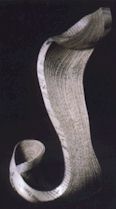
The Finnish jeweller Janna Syvänoja was trained as an interior designer and sought a way of becoming a jeweller that required no investment. The work I feature here displays pages from a telephone book that have been bundled and sewn together. She uses the paper like wood to carve forms. Unlike more obvious uses of recycling, which pulp substance to remove traces of its previous life, Syvänoja’s work celebrates the excess of paper. This Finnish perversion offers a necessary antidote to what at times can be an over-serious obsession in the Scandinavian world with natural balance. We might even consider future necklaces containing vials of radioactive waste as elements of future choice.
Fetishisation of materials
Getting back onto the main road, albeit travelling in the opposite direction, we return to a more elemental set of materials. One consequence of dematerialisation is an increased interest in the material substrate. This involves the basic material elements from which life is hewn, such as dirt, paper, water, hair, etc.
Such an interest, of course, goes against the grain of jewellery. Preciousness has traditionally been associated with scarcity, as understood by De Beers Consolidated Mines. This was articulately theoretically by the late Peter Fuller:
I believe that materials in the world, by reason of their inherent qualities, constitute a ‘natural’ symbolic order; and our perception of this seems bound up with our development of ethical and abstract concepts…the association between gold, wealth and power; granite, hardness and endurance; or mother-of-pearl and femininity is not arbitrary, nor is it economically or ideologically determined. Only someone who has become literally insensible could believe in the equality of materials.
Well, if Peter Fuller was alive today, he might well describe our condition as moving to the ‘literally insensible’. What he overlooked was the economy of materials. It is the transformation of this economy that many herald, such as John Perry Barlow, to whose words we here return:
With physical goods, there is a direct correlation between scarcity and value. Gold is more valuable than wheat, even though you can’t eat it. While this is not always the case, the situation with information is usually precisely the reverse. Most soft goods increase in value as they become more common….
By that logic, we might look to the most common materials as offering the greatest value. Where to begin?
 Water
Water
Here we have to take a leap. As a writer, I sometimes find phases in the argument that are particularly difficult to stitch together. I want to round up with water in my argument, but I’m not sure how it relates to what preceded it.
Until this move finds its appropriate logic, I am forced to rely upon a technological device. At this critical point in my argument, I’d like to turn what many consider the heart of the digital aesthetic. Few would question the place of the CD-ROM Myst as the hallmark success of multimedia as a new art form. To quote its accolades would be a tedious process here. I’d rather step into the world of its sequel, Riven. For our purposes, we can forgo the elaborate plot and immerse ourselves in one of the many worlds offered by this title. Whereas in Myst we began on an island surrounded by gently lapping water, here we start in what appears to be a forest that has been devastated by timbermen. We wonder through a winding path downwards until we reach a gorge that we traverse along a swing bridge. We stop and listen to the gently lapping water and gaze upon it shimmering surface. The water effects in Riven are one of its main features, to the point where the menu offers an option for ‘Water enabled’.
It’s a common element, certainly, that links people together with their cosmos. It’s also an element at odds very much with the process of digitisation, which is a kind of freeze-drying. This is evident in the way the word ‘wet’ has become synonymous with pre-digital technologies, such as the photographic darkroom or the ‘wetware’, a word used to denote the human brain. The obsession with water in a title like Riven can be seen as a fascination within the digital for the material world that it precisely seeks to transcend.
 Semitic
religion
Semitic
religion
This sudden appearance of water in the dry heart of digital culture gives us a license to cast our thoughts back to the early uses of water in Judaic cultures.
There is a trace of water in the history of jewellery, particularly religious ornament. In the Semitic religions, sacrificial rituals often involved a sprinkling of water. Initially, this was performed using a branch that is dipped in water and waved about. Thus the line from the Psalms (51:7): ‘Purge me with hyssop, and I shall be clean: wash me, and I shall be whiter than snow.’ Today, the Greek Orthodox Church retains this ritual at Easter when a bunch of basil is used.
Water has its general role in religion. It forms part of the overall concern for purification, the word for which, Taharah, is held in common between Islamic and Judaic religions.
The place of this purification sacrificial ritual is given an interesting nuance in the story of the Red Heifer. With the sacrifice of the animal, the ashes are gathered and mixed with water to anoint the believers. According to a Judaic expert, the use of water here provides a balance to the destruction of sacrifice. In burning, the animal passes beyond this world as smoke rises to the sky. The dispersion of water brings this ritual back down to earth.
Casting aspersions
My own personal confrontation with this ritual came through the Catholic Church. One of the many mysteries of the church was the way the priest sprinkled holy water on the congregation early in the service, using a silver rod with a perforated container called an aspergillum.
If it were possible to relieve us of the weight of Catholic doctrine, such a rite might seem appropriate to an age such as ours. In accounts of the Last Days of Pompeii, the feast is topped by a lavation of hyssop before ‘a small circular table that had been placed in the space opposite the guests suddenly, and as by magic, seemed to open in the centre, and cast up a fragrant shower, sprinkling the table’ before dancers appear.
Today’s growing consumption of house perfumes may result from a physical withdrawal of sensations, associated with prescribed drugs such as tobacco and heavy alcohol. The advent of oil burners and aromatherapy is now extending to the sale of aspergilla in perfume shops. In Levantine manner, such as aspergillum can be used for sprinkling water scented with rosewater through a house. One might expect new lines of silverware for dispersing water more subtly than pistols or lawn sprinklers.
 Old
Zealand
Old
Zealand
One last stepping stone back to where we are. A recent trip to Northern Europe brought me to two old ‘Zealands’—in the Netherlands and Denmark. These tiny clusters of land are, metaphorically speaking, jewels in the globe. On the other end of the world, Tasmania and the ‘New’ Zealand provide an antipodean reverse of these maritime jewels. It is from such regions that one might look for
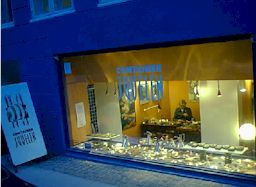
I’d like to finish on an up note by turning to one of these ‘Zealands’, Denmark’s city of Copenhagen. This city must have the highest density of quality jewellers in the world. In this, the week before Christmas, candles are lit to lure customers at all hours of the day. From benches behind their shop windows, eyes of jewellers follow pedestrians down lanes granting the city a kind of metal consciousness.
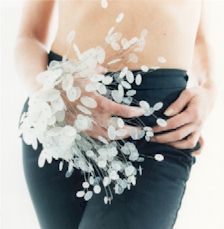
Among the many fine jewellers who work this city is Mette Saabye. This elegant bracelet, called ‘Drops of Dew’, is made from mother of pearl. The shower of white petals suggests more a shower than dew. In the whole, though, the work successfully attempts to capture the play of water and the grace that it sometimes lends to the moment.
If global warming continues along its current trend, then these jewels of continents are likely to submerge beneath a much greater mass of water. The counter to this threat demands a change of consciousness. The hunger for economic growth and dream of mega-cities needs the antidote of a consciousness attuned to things beyond the bottom line. In that regard, we may well enlist jewellers to fight water with water.

Copyright held by author Kevin Murray
For permission to reproduce this article, please contact Kevin
Murray