Imagine an Inter-national Craft
Source
This monograph was commissioned as part of a residency at the 1998 Haystack Summer School, Deer Isle, Maine
 ‘Imagine
there’s no countries… sharing all the world… and the world
will live as one.’
‘Imagine
there’s no countries… sharing all the world… and the world
will live as one.’
1971 was not a peaceful year. While Brezhnev and Nixon maintained their Cold War distance, either side of the Iron Curtain, other grievous figures emerged: Dirty Harry, Clockwork Orange, Erich Honecker and Idi Amin. Twenty-seven years ago, John Lennon’s plaintive Imagine seemed a glimmer of reason in a world tearing itself apart.
Today, Lennon’s impossible dream seems like our everyday reality.Sameness rather than difference is the natural condition of our late twentieth-century world. We currently enjoy a homogenizing global culture in which a standard set of consumer goods is available almost anytime and anywhere in the world. We can find Nike in Saudi Arabia, McDonalds in Moscow and News Corporation in China. Sometimes it seems wrong. To paraphrase the famous Zen koan, we hear the sound of one hand clapping.
In bringing the world together, it would be a shame if globalizing technologies served to erase rather than promote cultural difference. In this case, the best way of achieving cross-cultural exchanges may be to go ‘offline’—beyond the communication grid. Late summer of 1998, Haystack organised an International session, presented by a Welsh blacksmith (Ann Catrin Evans), a Dutch papermaker (Peter Gentenaar), a Fijian and American wood-carvers (Makiti Koto and Katrina Madsen), a Korean paper-maker (Chunghie Lee), a Japanese ceramicist (Shiro Otani), and a French-Australian jeweller (Pierre Cavalan). The very word ‘international’ seems today almost quaint, by contrast with the more contemporary ‘global’. ‘International’ retains some hint of difference within the sameness, whereas ‘global’ more easily overlooks cultural boundaries.
 In
an ‘international’ spirit, therefore, the challenge at Haystack
is to bring together different cultures from various corners of the world
in a way that avoids platitudes of ‘diversity’. While the material
results of this mix are difficult to pin down, I’ve attempted as
a writer to place this task within a craft context.
In
an ‘international’ spirit, therefore, the challenge at Haystack
is to bring together different cultures from various corners of the world
in a way that avoids platitudes of ‘diversity’. While the material
results of this mix are difficult to pin down, I’ve attempted as
a writer to place this task within a craft context.
Today, craft inherits a way of doing things that is at odds with the mainstream. While the world is moving away from the bench to the screen¼from the typewriter to the word processor¾it is closing the book on an adventure that has lasted thousands of years. In an ‘information society’, the advancement of knowledge is usually considered the core story of human civilization. Often overlooked is the intense struggle with the materials from which our world is made possible—the bookbinders behind the theories.
During the idyllic fortnight spent at Haystack, I kept asking myself the same question¾is it real? The first reason for suspicion was the absence of insects. As an Australian, I know summer as a season where an army of buzzing creatures declares war on human flesh. Like beleaguered soldiers, we wearily exchange the ‘Aussie salute’, waving our hands across our faces to dislodge the flies, momentarily. Haystack was eerily peaceful in this regard.
The second clue to unreality was the weather. Each day at Haystack seemed to follow the same pattern. We wake to fogs that surround the island in a mysterious cloud. By afternoon, sun burns away the mist to reveal sharp blue skies. And at night, wild thunderstorms light up the woods making day for night. I suspect we are on a meteorological loop.
The final and most telling clue to this stage management was the scenery. I’d seen it all before¾on a computer screen. With an interest in emerging fields of craft, I had cause to study the most popular non-violent CD-ROM, Myst. Here also was the network of islands, the geometric wooden architecture, the spruce forests and the granite meeting the gently lapping sea¾all swathed in a misty light. I am tempted to try clicking one of the outdoor light posts, to see what new screen would emerge.
For the first few days, jet lag blends with culture shock to create a sense of unreality. But eventually, just as the mist evaporates into the afternoon sky, my existential vertigo dissipates. For that, I have one special element to thank¾the culture of Haystack.
At Haystack, visitors encounter not only exquisite works of art, but also the chapped hands that laboured over them. Many of these are ‘masters’, who have dedicated their lives to the subtle refinement of their medium. But masters are not the majority. At their hands and feet are exponents of crafts foreign to Haystack, such as table waiting, surgery or secretarial work.
For many of these moonlighters, Haystack is a once in a lifetime experience. Their ecstatic contact with a sacred site of craft is kneaded back into their ‘normal lives’. We are unlikely to learn how this occurs; we can only imagine the pockets of respite retrieved from work pressures, when abstract forces are seized like material threads and woven into acts of substance. In these situations, a paragraph, abdominal incision or difficult customer is dealt with in the same quiet resolve as a lump of clay is thrown into a pot.
 From
what I hear of other craft workshops, Haystack is distinguished by its
lack of elitism. There are subtle ways in which Haystack encourages this
collectivity: 24-hour access, even if not availed, weakens the routine
boundary between work and home. In our normal lives, the daily commute
creates an inexorable division between public and private. We become accustomed
to leaving something of ourselves behind, in whichever direction we travel.
In work we forget our solicitude, and at home we ignore our intensity
of purpose. While this is a necessary sacrifice in the emotional economy
on which the other economies run, it is just as necessary that we occasionally
leave the door open. Work and home are, after all, connected. And in Haystack,
you need never be ashamed of working in your pyjamas, or crying at your
bench.
From
what I hear of other craft workshops, Haystack is distinguished by its
lack of elitism. There are subtle ways in which Haystack encourages this
collectivity: 24-hour access, even if not availed, weakens the routine
boundary between work and home. In our normal lives, the daily commute
creates an inexorable division between public and private. We become accustomed
to leaving something of ourselves behind, in whichever direction we travel.
In work we forget our solicitude, and at home we ignore our intensity
of purpose. While this is a necessary sacrifice in the emotional economy
on which the other economies run, it is just as necessary that we occasionally
leave the door open. Work and home are, after all, connected. And in Haystack,
you need never be ashamed of working in your pyjamas, or crying at your
bench.
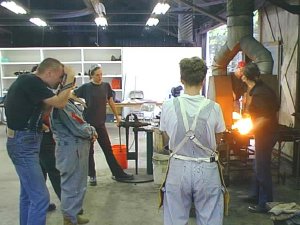
During the first few days of the workshops, much time is spent becoming acquainted with the appropriate tools. As the agents of making, it is critical that our bodies fully acquaint themselves with their new extensions. Even into the third day, the wood carvers are still learning how to effectively sharpen their instruments. Meanwhile, in blacksmithing, the makers spend the first two days ‘bootstrapping’ themselves into action by making their own tools.
As a writer, it is difficult not to be infected by this prolonged preparation. It provides a space in which to contemplate the rudiments of thinking. Taking a phenomenological line, the craft of thinking is very much about learning how to balance opposing forces. This balance is maintained by alternation between two processes—bringing together and pulling apart.
In normal life, this process becomes sedimented. We can take for granted both the bizarre events in Russia and the reasonableness of life at home. But as Heraclitis has said, ‘The mixture that is not shaken soon stagnates’. Where writing can make a difference is in stirring up the dust¾in linking what is kept different, and separating what is normally taken together. Hopefully, such writing might assist productive pursuits to find a similar balance.
My reflection on Haystack is therefore a journey along the landscape of craft, more particularly, a path through the valley of oppositions in which craft is situated. My initial companions were the group who gathered every afternoon in the writer’s shack to unravel their thoughts and rest their hands. They helped shape the passage we follow here. I hope that by the end of the journey, we might have refreshed our understanding of the broader physics of which individual acts of craft partake.
Hunter and herdsman
The management of things
One of the basic considerations in making concerns maintenance of materials. Lewis Mumford identified two alternative patterns of care in the distinction between ‘herdsman’ and ‘hunter’. According to Mumford, the herdsman survives by nurturing his source of food, whereas the hunter captures his prey with little regard for the world from whence it comes.
Mumford’s bias is against the hunter. For Mumford, the hunter exemplifies a lack of regard for nature that lies at the heart of capitalism unbounded by responsibility for either community or environment. As an abstract device, however, this division reflects two equally valid forms of creative engagement.
 A
paradigmatic herdsman is the English ceramicist Bernard Leach, who recommended
that ceramicists dig up the very clay they use in their pots. This self-sufficiency
extends beyond the ideology of the 1960s. Today, it is common for paper
artists to grow their own specialist fibre. Many wood artists only use
off-cuts to reduce the toll of their craft on native forests. Craft is
home territory for environmental sustainability.
A
paradigmatic herdsman is the English ceramicist Bernard Leach, who recommended
that ceramicists dig up the very clay they use in their pots. This self-sufficiency
extends beyond the ideology of the 1960s. Today, it is common for paper
artists to grow their own specialist fibre. Many wood artists only use
off-cuts to reduce the toll of their craft on native forests. Craft is
home territory for environmental sustainability.
Yet, for every herdsman there is a noble hunter. The hunter lies in watch for an auspicious moment in which treasure might be seized. Such an approach need not lead to murder, it can simply amount to scrounging. And at Haystack, there is a tradition of jeweller as scavenger. The Australian jeweller Pierre Cavalan specialises in assembling a variety of otherwise useless items into a precious syntax of a necklace or brooch. In finding happy combinations, such as the seven items that spell ‘Haystack’ for his tribute work, Cavalan retrieves the honour of ornament from the excess of branding that afflicts urban life.
In conversations around this theme, there was a sense that modern life needs to restore contact with the mode of the hunter. Much consumerism is plainly an enjoyment of the fruits of hunting, yet foodstuffs emerge anonymously onto supermarket shelves with little regard for the elemental process of life and death it has endured. At least the act of killing one’s supper provides an honest acknowledgment of the sacrifice necessary for human life to continue.
Tree and root
The organization of things
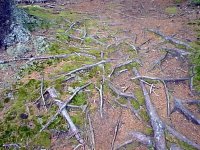
Experience tending the land has generated its own particular opposition: thetreethat extends as a singular form to the sky, and therootsthat dig deep in their multiplicity through the soil. The tree is a creature of light that absorbs the energies of the sun towards which it grows. By contrast, the roots are creatures of dark, which absorb water lying in the depths of the earth. Strangely, they are part of the same organism.
This opposition is such a compelling metaphor on which to hang thoughts that two French philosophers, Gilles Deleuze and Felix Guattari, developed a whole body of thought around it. InA Thousand Plateaus, they draw a parallel between trees and the Western form of knowledge. For Deleuze and Guattari, the tree is hierarchical: many branches serve one trunk. This ‘arborescent’ order is characteristic of a way of thinking which reduces experience to a single entity, such as ‘common sense’ or ‘truth’. Their hearts lie with its antithesis, which they call ‘rhizomic’. Like the roots of a tree, the ‘rhizomic’ spreads horizontally without particular order—it thinks in Haiku rather than sonnets, chance rather than prediction, waves rather than ripples. Rhizomic forms include potatoes, insect colonies, burrows, Asian cities and the Internet.
With a French tendency to the absolute, Deleuze and Guattari are defiant about the virtues of the rhizomic
We should stop believing in trees… They’ve made us suffer too much. All of arborescent culture is founded on them, from biology to linguistics. Nothing is beautiful or loving or political aside from underground stems and aerial roots, adventitious growths and rhizomes.
Dig it! On the surface, Haystack seems an especially good environment to consider this underground movement: spruce trees rise up from the ground in dead straight formations, while their roots create a complex web across the soil, to the hazard of many absent-minded strollers.
Yet to simply affirm roots and deny trees is a limited move. While we can appreciate the hidden powers of the roots, we need to acknowledge that they exist to serve a ‘higher’ purpose. These days, it is a little harder to accept that there might also be a place for a singular truth—an island in a sea of relative opinions. We have swung so far in one direction that we lose sight of the other.
 Mind
and hand
Mind
and hand
The construction of things
The human body is an enduring structure on which to hang together thoughts. Its principle duality is the controlling presence of the mind and the instrumental powers of the hand. Since the Greeks, the superior power has resided in the capacity of thought rather than fabrication. Philosophers such as Locke compared the hands to slaves that must fulfil the duties demanded of them by our consciousness.
This position should be so familiar it barely needs mention. But we know also that hands do not always conform so obediently to this arrangement. Indeed, there are many situations where hands might be seen to have a ‘mind of their own’, even beyond our conscious control.
Aristotle called the hand a ‘tool of tools’. As a ‘built-in’ prosthesis it sometimes has an instrumentality that is foreign to us. The German late-romantic poet Rilke animates the hands when describing the work of Rodin.
Hands have a history of their own, they have, indeed, their own civilisation, their special beauty; we concede to them the right to have their own development, their own wishes, feelings, moods and favourite occupations.
Rilke’s ‘kingdom of hands’ demands more artistic license than we might otherwise grant a metaphor, but it’s a useful conceit. The hand as an agent in itself is often used to estrange us from this familiar part of ourselves, to appreciate how central the act of making is to the heart of our existence. We are the stuff of hands before minds—hands that pulled us from the womb and held our trembling body.
With computer technologies, we move further away from that point of origin. As e-mail replaces hand-written letters, the expressive role of hands in communication lessens. Though computing is still dependent on the use of hands—tapping a keyboard and clicking a mouse—movement has been reduced to pressing and there is no place for the most subtle of manual powers, the hold. But even this minimal involvement of hands will cease: voice-controlled software promises to grant us an almost telepathic control over our lives. Unlike throwing clay pots, hands have no integral role to play in the development of information technologies.
Along these lines Kevin Kelly, editor ofWiredmagazine and author ofOut of Controlheralds a ‘thumbless’ future. He argues that, while there have been particular evolutionary developments that were critical for survival, they have no longer any use once their part is played. Thumbs served in the construction of the tools that eventually replaced them. Having run their length in the evolutionary relay, hands are free to kick up their heels (or rather ‘palms’).
Yet at the same time, hands re-emerge in the strangest of places, such as the character ‘Thing’ in the television series,The Addams Family. ‘Thing’, the tireless messenger, grants audience from a small wooden box. The object of comedy here is Thing’s uncanny ability to communicate complex messages and understanding to his mistress, Mortitia Addams.
Interestingly, the ‘Thing’ of the recent film versions has been liberated from the box and freely moves around the world, even on a skateboard. This unshackling of the hand reflects a change in telecommunication¾from stationary pay phone to mobile phone. This re-engineered Thing reflects the supposed freedoms now possible once we are no longer dependent on location in order to produce objects.
In any Haystack workshop you see a crowd of ‘Things’, both dexterously manipulating materials and dramatically gesturing to fellows. For many office workers, Haystack is a ‘holiday for the hands’, where participants can re-sensitize their touch, put confidence back into their grip, and fine tune their fingers.
While we enjoy the spectacle of hands playing free of consciousness, like the roots of a tree we must acknowledge their ultimate dependence on direction from the mind. Just as German philosophers can talk about the ‘craft of thinking’, so we must admit to the force that guides our hands. In Haystack, the mind follows hand as the night follows day: evening seminars and readings grant opportunities to think about frames in which to place our productions.
 Rare
and common
Rare
and common
The economy of things
In a more abstract sense, the relationship between the one and the many is particularly striking in the way we value objects and events. Our economy is structured on the value of the rare item, as opposed to the common property. The price of minerals is directly proportional to their rarity, more or less. By a similar logic, singular events in a life such as weddings are valued above the routine weekdays in which patterns of behaviour are repeated. Certainly, in decorative arts collections, rare items such as one-off porcelain statuettes are featured before objects such as coffee mugs, despite being more useful to a greater number of people.
The opposition between rare and common challenges writers, whose craft it is to frame our experience in words. To value only the singular events would be to deny the greater part of our life. One poet who accepts this challenge is John Ashbery. In this remarkable passage fromThree Poems, Ashbery attends to the way the temporal structure of a day might provide a logic for the span of a human life that contains it.
[The day] is a microcosm of man’s life as it gently wanes, its long morning shadows getting shorter with the approach of noon, the high point of the day which could be likened to that sudden tremendous moment of intuition that comes only once in a lifetime, and then the fuller, more rounded shapes of early afternoon as the sun imperceptibly sinks in the sky and the shadows start to lengthen, until all are blotted in the stealthy coming of twilight, merciful in one sense that it hides the differences, blemishes as well as beauty marks, that gave the day its character and in so doing caused it to be another day in our limited span of days, the reminder that time is moving on and we are getting older, not older enough to make any difference on this particular occasion, but older all the same.
Through foreign eyes this reverence for the epic in the ordinary seems a particularly American trait. The lineage of writers from Ralph Waldo Emerson to Richard Ford consecrate the everyday with an authority, awesome in its modesty.
The obverse of this New England pastoral is Russian romanticism, with its desperate attack on the inertia of everyday reality (known in Russian simply as ‘being’, or ‘byt’). Its most dramatic exponent, Vladimir Mayakovsky, attempted to break through the callused senses as a service in the greater revolutionary project of smashing the past.
			 Forward!
            Painting Mondays and Tuesdays in blood
            We shall turn them into holidays
There’s no question that Haystack was imbued with the pastoral spirit. The day had a consistent routine—breakfast, lunch and dinner are all about equal in their degree of formality and occasion. Yet taken as a whole, the fortnight session was geared to the final showing, in which work by participants is displayed for public viewing and private assessment.
Perhaps the most frequent reflection about staying at Haystack concerns our experience of time. The days lend themselves to a sense of timelessness, yet its end seems to accelerate the closer it gets. It is a rare sense of commonness.
 West
and East
West
and East
The movement of things
At the dawn of the 1990s, it seemed that the time-honoured subservience of the east was changing. The ‘Asian tiger’ was growing in confidence, and China was given the box seat to take over Russia’s role as the alternative superpower. Then in July 1997, Thailand abandoned the fixedBaht, which promptly fell through the floor, taking the rest of Asian economies with it. Since then, Western economies have continued to flourish, albeit casting the occasional backward glance, while southeast Asian societies seem to have been thrown back to a quagmire of ‘orientalism’—religious fanaticism and political corruption.
During the international campus, one of the few pieces of news to filter through concerned the bombings at Planet Hollywood in South Africa. Along with continued tension between the US and Iraq, it seems as though little has changed since the medieval battles between the Christian and Muslim empires. East-west rivalry has outlasted the industrial revolution, world socialism, global capitalism and the information society. How is it that this little planet got divided up into two halves?
Though the title of Asia goes back at least to ancient Greek times, it is very much a Western invention. The Chinese name for it, ‘Yazhou’, is itself borrowed from abroad. This difference has usually been a negative one: to the east are the inscrutable, barbaric and inhumane peoples.
One of the most powerful antidotes to this global split has been the post-colonial movement in Western academic circles. It has become common in the universities to question the whole existence of the ‘orient’ as a Western construction. The Palestinian writer, Edward Said, claimed that the exotic picture of the east did not exist in reality, but was constructed to service the careers of Occidentals who found causes to uphold—particularly the rescue of ‘antiquities’ from contemporary Arabs.
One dangerous side-effect of the post-colonial critique is that it can transform all encounters with the ‘other’ into simple projections of our own sense of the exotic. Too much self-consciousness can be disabling. ‘Is there any point in meeting a Chinese if all I do is project my own fantasies onto him?’ We still need to encounter a different way of thinking, simply to understand ourselves.
To this end, we need to think again how west is west and east is east. The Western manner of starting things from scratch, whether in systems of knowledge or agriculture, bears obvious fruit in the advancement of science and technology. Its antithesis is the more traditional understanding of the world, which is by definition less systematic. This is how the Western authors such as François Jullien characterise ‘Chinese reasoning’:
Chinese reasoning… seems to weave along horizontally, from one case to the next, via bridges and bifurcations, each case eventually leading to the next and merging into it. In contrast to Western logic, which ispanoramic, Chinese logic is like that of a possible journey in stages that are linked together.
In the terms we have established thus far, the eastern way of knowing is rhizomic: it progresses without constant reference to a core system of truth. As such, it is attuned to the flows of events, or ‘chi’, that characterize natural patterns in material and social life.
While there are many examples of where such reasoning clashes with the West—such as impatience with the evasive responses of its oriental host—there are many lives that intersect the two, and in doing so inform us how they might co-exist. Yoko Matsubayashi, the teaching assistant for the visiting Japanese ceramicist Shiro Otani, presented an artist’s statement in her talk to Haystack faculty:
I lie somewhere between East and West, rural and urban, winter and summer, inhibited and wild,¾yinandyang. This relates to the situation that I am in. I am between two different cultures. I am in America, but I am Japanese.
I only know I like clay. Clay helps to express my imagination that changes every day. I feel as if I am water. In winter the river freezes. After a heavy rain, the water rages. Water takes on any shape and changes freely. Water can be ice. Water can evaporate into air. But water is water. I live in two cultures, but I am I.
These dualities offer a series of threads from which meaning can be woven. There are ways clearly to organise alliances between them. The Oriental offers a rhizomic knowledge that privileges the daily cycle and contemplation, rather than the hands-on Occidental approach that seeks the rare core of truth from which all else will follow.
Yoko’s reference to materials, in this case the element of clay, indicates how those working with the poetry of materials can explore the intersection between two forms of life. The physical continuity of the world persists through ideological difference. Here we move to the next duality, between matter and its meaning.
 Life
and art
Life
and art
The enjoyment of things
Within the discipline of sociology, across many different cultures, there is one fundamental division that can always be found in the analysis of our behaviour. It can be so obvious as to seem insignificant, but its pervasiveness is profound. The division concerns thepracticalandexpressivedimensions of behaviour. There are acts motivated by practical considerations, in which the resources necessary to maintain life are gathered. Complementing these are acts whose intention is not practical, but expressive. You buy a car. You not only consider its mechanical condition (practical), but by virtue of its public status you must also consider its colour (expressive).
It was the psychoanalyst Donald Winnicott who discovered a parallel difference in the construction of self. In this picture of childhood, the development of creativity depends on two interrelated factors: boundary and space. The child has to have a sense of security (practical), but within that security there must be space for play (expressive).
This expressive-practical division is a rich device for looking at an individual’s attempt to make a life. While much of our care is spent securing the material structure of our lives, it is at least equally important that this work allows for a space which is enjoyed for its own sake. The most common element in this space is family.
But family is not the only means by which this expressive culture is maintained. Traditionally, Sunday has been the exception from the working week, when non-utilitarian display is encouraged—‘Sunday best’. In major cities where most people live, Sunday is becoming an endangered species. It has been argued that our expressive opportunities are declining with the advance of capital and the disappearance of the sacred. In these conditions, people often turn to art in order to secure that expressive bubble for themselves.
As an island, Haystack draws many people who are trying to escape their worldly success and pursue an activity for its own sake. These students are almost as distinguished as the Faculty, although in different fields.
Take the case of Nancy Klimley, technical director for Rhythm ‘n Hues, a Los Angeles animation company. Klimley is well known for her animal modelling, seen in Coke advertisements and films such asBabe, which has pioneered the synthesis of movement in fur. Despite this success, she searches for a space beyond the demands of others—a creative oasis where forms spring forth spontaneously.
So much of my work is based on making other people happy. It’s exclusively: Is my boss happy? Ishisboss happy? Is the client happy? Is the movie selling so the public is happy? When I’m doing my own work its just for me.
Working on some of the most powerful graphic computers in existence, Klimley takes time out to sit on a floor and carve into a block of wood. Such expressive moments are critical in staking out a creative life.
We are conditioned to believe that such moments are the exclusive prerogative of artists, though any life would be bereft of meaning without similar opportunities to define itself beyond practical needs. It seems an important legacy of the arts and craft movement that we acknowledge opportunities for expressive realization in all walks of life. Everyone has a right to lay claim to craft.
When you look deeply enough into any profession, you will find a craft metaphor. Take a profession we don’t normally associate with craft, such as dentistry. Apart from its financial success, dentistry lacks the expressive opportunities of craft. Like surgery, good dentistry is invisible. The mark of a professional is to make it seem as though no work has been done on a person’s mouth. This is diametrically opposite to crafts, where the mark of the maker is essential to the worth of an object. But we can find this mark back in the roots of dentistry.
Not all cultures treat dentistry as a purely medical profession. Until the Papal Edict of 1215, European dentistry was the province of monks, whose responsibility extended to other ‘barber-isms’ such as cutting corns and extracting bladder stones. This tooth-drawing was an intuitive craft with little or no science. Thus anyone with practical skills could pursue a spot of dentistry.
The legendary American patriot Paul Revere pursued his father’s profession of silversmith through the production of tea sets for the Boston aristocracy. But he also applied his craft to dentistry, where he manufactured artificial teeth. This link with jewellery remains today. At a local dental institute, a crown and bridge specialist is known as the ‘goldsmith’ of the profession. It is bench lore that jewellers treat a trip to the dentist as an opportunity to purloin a spare file or probe. Listen to the sounds of a jewellery workshop and you will hear the familiar sound of flexi-drive air drill, excavating and polishing.
This romance with jewellery is the antithesis of contemporary dentistry. The emphasis on prevention implies a negative picture of dentistry¾the less the better. There is no place in this kind of professional identity for an appreciation of the subtle manual skills required to conduct such fine work in a space that is wet, upside down and labile. One dentist reflects on an early influence:
My own dentist had a great pride in workmanship. I knew him as a person. I can remember the time when my father and he were building a caravan each together and his pride as he produced something to a ‘thou’. It always was—every little bit of woodwork was to a thousandth of an inch. His craftsmanship with wood and furniture, cabinet making was terrific. Some of the fillings he did for me, 35-40 years ago are still in place in my teeth and still functioning well, even though he has left this world some 10-15years ago. So the work goes on much longer than we do sometimes.
Given the access to goldsmithing equipment and previous metals, it is not surprising that jewellery is a popular past-time for dentists and dental technicians.
One of the curious discoveries in exploring the craft identity of a profession is the inverse reaction that takes place. Individuals will seek outside their work a way of counteracting the bias of their profession. A heart surgeon might confess to ‘cooking without recipes’ in order to counter the obsessiveness encourage by life-threatening techniques. One particularly philosophical dentist pursued an art outside the surgery of crude ‘rural’ sculpture. This had only limited success:
I quite like fiddling. I'm from the country originally and I always liked doing this. I'm always disappointed, though, that my attempts at rural manufacture always turn out to be too neat. I have never found out how you get that raw rudeness into rural manufacture if you like.
There is a fascinating ‘genealogy’ to be constructed of secret marriages between different walks of life. For many participants, Haystack is almost an ‘affair of the hands’, allowing them time out from the ‘day job’ in order to renew the expressive mystery at the heart of creation. This is the way Lithuanian-born philosopher Emmanuel Lévinas idealises work:
We might wonder if we should not recognise an element of art in the work of craftsmen, in all human work, commercial and diplomatic, in the measure that, in addition to its perfect adaptation to its ends, it bears witness to an accord with some destiny extrinsic to the course of things, which situates it outside the world, like the forever bygone past of ruins, like the elusive strangeness of the exotic. The artist stops because the work refuses to accept anything more, appears saturated. The work is completedin spite ofthe social or material causes that interrupt it.
Less removed from life than art, craft has the license to recover expressive moments from the most practical of activities.
 Inside
and outside
Inside
and outside
The location of things
Ripples of this dialogue extend beyond an individual life to grander questions of national identity. With the fall of communism in the 1990s has come a rash of nationalism. As the nation state collapsed in Eastern Europe, xenophobic sentiments grew like weeds between the cracks. Each of these racisms held to a dream of self-sufficiency—if only we could rid ourselves of the ‘other’—the Muslims, the Croats or the Serbs—we could finally control our destiny. In recent years, thePauline Hansen’s One Nation Partyin Australia has been running a similar line about the growing proportion of Asians.
The contrary movement is towards difference, and the embrace of what is other. The most celebrated centrifugal moment is marriage, where the sexual and kin difference is brought together. We know this tendency politically in the support of minorities and celebration of cultural difference. Enjoyed to excess, it can lead to a denial of one’s own place in the world, in favour of those who are more ‘different’, exotic and other. Of late it has been dampened by the label ‘political correctness’, which is a way of discounting any dialogue with interests beyond the mainstream.
Without an ideological push, the default position seems to view national traditions in isolation from each other. This certainly is a picture encouraged by the displays of decorative arts in museums. The reality is usually quite different.
Many myths of national identity have as their founding moment a borrowing from elsewhere. A striking case for this symbolic exogamy is the identification of countries in Western Europe with the Levant. Grundtvig, the great reformer who planned modern Denmark, proclaimed ‘Denmarkishistory’s Palestine.’Similarly, the great historical figure of Jacob Cats, also known as ‘Father Cats’, whose moral verses informed Dutch empire of the 17thcentury is eulogized as the one ‘Whom Holland made Jerusalem.’ While England was celebrated in verse as the New Jerusalem, there was much identification at the height of the British Empire with the ancient Phoenicians. Figures like Matthew Arnold, Rudyard Kipling, Arthur Conan Doyle and William Gladstone all professed an association between the modern English and the noble race of seafarers. Such an identification served to strengthen their link with the source of history in the Semitic peoples, without the perceived dolour of the Hebraic races.
Such borrowing is particularly strong in the national craft traditions. The dominance of porcelain in Western Europe is of course a Chinese borrowing. The eighteenth century ‘China mania’ is just one of many waves of Oriental influence that have swept through Europe.
But take a specific case like Russia. Many of their major crafts turn out to be derived from Japan. In the early 20thcentury, various items were imported for gift shops, including a figurine of a Buddhist sage, known as Fukuruma, brought from the Japanese island of Honshu. This doll contained others nestled inside it and its popularity sparked the Russian tradition of Matryoshka. Also among those imports were exotic items of lacquer-ware. This provided the basic structure and technique for the miniature painting, the finest expression of Russian craftsmanship found today. Lacquer-ware was the communist displacement of icon painting, which itself was borrowed directly from the Greeks along with the Orthodox faith in the 10thcentury.
Far from being an exception to the self-contained evolution of traditions, this ‘foreign knowledge’ at the heart of creation is endemic to a dialogic understanding of identity. We are for others, or as Lévinas writes: ‘My being is produced in producing itself before the others in discourse; it is what it reveals of itself to the others, but while participating in, attending, its revelation’.
Return
While I might take the exogamous position, I cannot exclude the necessity of identity. I simply maintain that we need to provide a space for difference. The chorus for this today consists of a variety of movements. The call for protection of biological and linguistic diversity is based on the threat of globalization as it leads to a homogenisation of the natural and built fabric of the world.
In Australia, this call is acknowledged in the political movement known as ‘multi-culturalism’, which is based on a notion of nationhood that embraces cultural difference. The value that enables this difference to flourish is derived from the reformist spirit of a convict colony—everyone deserves a ‘fair go’.
But there are limits to this. The challenge is to open the doors without losing the walls. How do we expose ourselves to foreign influence without losing our own sense of identity completely? The danger is to panic at this point and brick over the doors. The best counter to this closure is a recognition that our identity comes from outside.
From that comes a particularly effective synthesis, such as James Joyce’sUlysses, which draws on the ancient Greek epic in order to depict the very everyday life of Dubliners. As the Germans would say, it takes a long journey to get to where you started. The journey taken in this instance has navigated through a series of oppositions that help constellate the meaning of craft. To the left is the range of the one: hunter, tree, mind, rare, west, life and inside. This is the isolated individual who reaches for the absolute at great risk of life. To the right is the series of the many: herdsman, root, hand, common, east, art and outside. What is important here is the interconnection between elements, rather than their intrinsic identity. Clearly, identity and difference are part of the same landscape.
To maintain these two forces, it is necessary to create a space between them. Haystack functions as a space in which we can contemplate the relationship between these two forms of life. On its ideal journey, we can gather and hunt, observe trees and their roots, engage our mind and hands, enjoy the rare and the common, relate East to West, carve art out of life, and find ourselves in others. By the end, we should be back where we started.
The world seems a strange place after a fortnight on Deer Isle. I spent my first night out of Haystack in Bangor with Pierre Cavalan, a compatriot jeweller (though of French birth, he is an honorary citizen of the United States of Australia). To begin the evening, we chose to hit the real grit hard and see a movie. As it had yet to open in Australia, we decided on the Truman Show, the film by an Australian about how unreal American reality can be. I had obvious reason to recall my first doubts at the authenticity of Haystack.
Filing out of the cinema, through the featureless mall interior, we made our way outside. There, on cue, a taxi was waiting—the same taxi we had taken to the mall. Haystack now seemed positively real by comparison with reality outside.
Sources
John AshberyThree PoemsHarmondsworth: Penguin, 1972
Gilles Deleuze & Felix GuattariA Thousand PlateausMinneapolis: University of Minnesota Press, 1987 (orig. 1980)
François JullienThe Propensity of Things:Toward a History of Efficacy in ChinaNew York: Zone (trans. Janet Lloyd), 1995 (orig. 1992)
Bruce KirmmseKierkegaard in the Golden Age of DenmarkBloomington: Indiana University Press, 1990
Emmanuel LévinasTotality and Infinity:An Essay on ExteriorityThe Hague: Martinus Nijhoff (trans. Alphonso Lingis), 1979 (orig. 1961)
Emmanuel Lévinas ‘Reality and its shadow’ inThe Lévinas Reader(ed. Sean Hand) Oxford: Basil Blackwell, 1989 (orig. 1948)
Vladimir Mayakovsky `Cloud in Trousers’Mayakovsky: The Bedbug and Selected Poetry(trans. Max Hayward & George Reavey) Bloomington: Indiana University Press, 1975 (orig. 1915)
Rainer Marie Rilke ‘The Rodin Book’Rodin and Other Prose PiecesG.C. Houston (ed.) London: Quartet, 1986 (orig. 1902)
Simon SchamaThe Embarrassment of Riches: An Interpretation of Dutch Culture in the Golden AgeLondon: Fontana, 1991 (orig. 1987)

Copyright held by author Kevin Murray
For permission to reproduce this article, please contact Kevin
Murray